This issue of Archaeology Ireland features a five page account of the Beaubec excavations. The magazine’s editor, Sharon Greene writes: ‘Geraldine and Matthew Stout’s article on their excavations at the medieval grange of Beaubec, Co. Meath, also reals changes in the past and present. They managed to excavate this summer despite all the new health and safety measures of social distancing, mask wearing and additional sanitising, and they share here their interesting discoveries—not least of which was a pottery vessel potentially associated with a much earlier pandemic. Thinking of the devastating effects of the Black Death on the Irish population in the fourteenth century is enough to make one very thankful for the medical advances that have been made since.’
A subscription to Archaeology Ireland makes a perfect Christmas gift!
Every year the Royal Irish Academy in association with Queen’s University Belfast offers radiocarbon dating for up to twelve applicants to be used for the purposes of archaeological research in Ireland. We are thrilled to announce that Beaubec excavations has won one of these awards and will use it to date the charcoal layer at the base of the pit in Cutting K. This pit may be part of a Late Neolithic pit circle. Getting this award will tell us, one way or another, if there there is a Late Neolithic horizon at Beaubec.
Tom and Penny sample the burnt material from the pit in Cutting K.
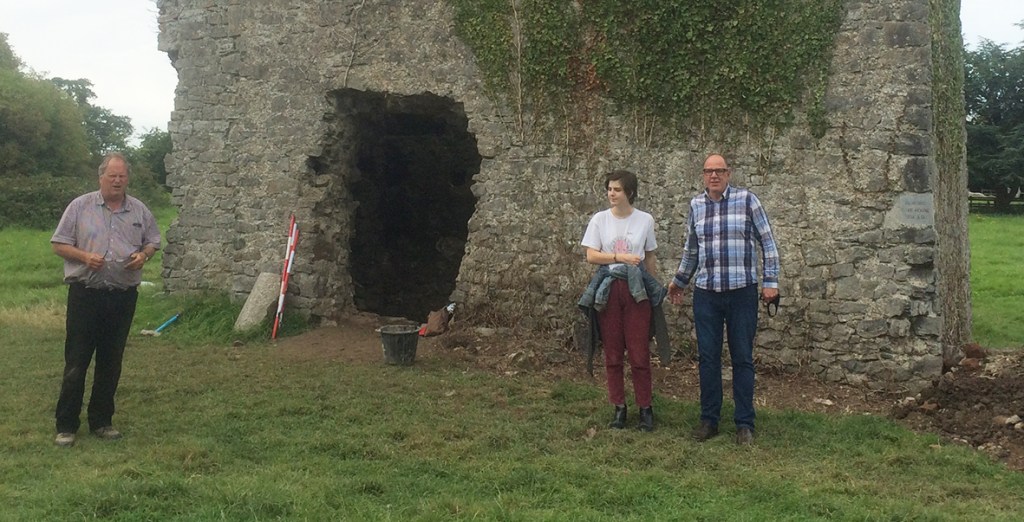
In a breathtaking initiative from the Minister of State for Heritage and Electoral Reform, Mr Malcolm Noonan, grants were made available for the development of Conservation Management Plans for archaeological monuments in private ownership. These grants, awarded by the National Monuments Service, are aimed at identifying measures for conservation of monuments and improving public access. Beaubec has received one of these grants! John McCullen made the application for this funding with the support of Meath County Council’s Heritage Office Loretto Guinan. The award of €5,000 will go towards an assessment of the conservation needs of the Service Tower at Beaubec and the preservation and presentation of features uncovered during the recent excavation. This award has enabled the Beaubec Project to commission a site assessment from Chris Southgate of Southgate Associates, Middleton Co. Cork. Southgate Associates is one of Ireland’s longest established specialist heritage conservation practices. Co-director of the excavations at Beaubec, Dr Matthew Stout, is the archaeological advisor for the project.
Land owner John McCullen (left) and conservation architect Chris Southgate discuss the Conservation Management Plan at Beaubec.
The Beaubec excavations have featured in Smithsonian Magazine! Drawing on newspaper articles by Louise Walsh and Alison Comyn, science journalist Alex Fox has presented our successful season to an international audience. The article features a link to our blog and to our twitter presence. Read all about it:
In another international development, Beaubec has featured in an online science magazine in Poland. The article by Anna Błońska can be viewed using the following link.
Drogheda Journalist Louise Walsh wrote a piece for today’s (Monday, 21 September 2020) Irish Independent. It beautifully captures both our discoveries from the last season and the precautions that we had to take on account of the Covid virus. Head out to buy your copy now!
A last bit of recording and survey needed to be done in the larger cuttings before the formal hand-over of the context sheets and plans by the supervisors to the directors. Everyone else was involved in a frenzied tidy-up of the site to get it ready for its close up. Anthony Murphy, of Mythical Ireland fame and author of many books including Island of the setting Sun, very generously offered to take drone shots of the site. Fortunately, we had a narrow window of sun before the heavens opened and we all ran for cover. The tools were all cleaned and brought up to the shed for another season. Ever enthusiastic, Mary Sherlock, with Donal and Luke, was the last woman standing (that is still excavating) in a recently opened cutting. In the afternoon we had our traditional end of excavation do and distribution of the 2020 season T-shirts based on Peter McCullen’s fabulous design. John McCullen thanked the team and made a presentation to the co-directors of beautiful bespoke Irish pens made from a fallen tree at Beamore. The directors, in turn, thanked the supervisors, volunteers, specialists, extended McCullen family and FBD Trust for their support.
Day 20 saw the completion of a very successful second season of excavations on the McCullen farm at Beamore, County Meath. We had a large enthusiastic team made up of archaeology students and post-graduates from DCU, UCD and DKIT with a solid core of volunteers from the local community and beyond. Our excavation is being followed by a virtual community through this blog and will be featured in the Farmer’s Journal, Drogheda Independent, Irish Times and in a forthcoming film episode of the John Creedon programme. Our Twitter account, maintained by Billy Sines, went from 80 followers to 200 followers. This season we pushed back the dating of human settlement at Beabec with the discovery of a prehistoric ceremonial pit circle and stone tools beneath the medieval monastic farm. We more than doubled the number of finds this season with a broader range of material than last year. This included medieval wine jugs and storage vessels from Drogheda, Dublin, Cheshire, Bordeaux and Normandy in France, medieval floor tiles and window glass, plough pebbles, and metalwork. We are particularly fortunate at Beaubec to have waterlogged deposits in the latrine block and ditch which allows worked timber and seeds to survive. Our wooden finds this year include part of a medieval butter dash churn. Surviving oak timber planking which formed the roof of the latrine vault will help with the dating of the tower. Excavation this summer revealed further evidence for mixed farming by the French Cistercian monks in the thirteenth/fourteenth century. Their stock included sheep, goat, cattle, pig and poultry. They grew peas, beans, oats, wheat and rye. They also had fruit gardens and grew damsons, plums, sloes and elderberries. Their imports included grapes and figs probably from their home abbey of De Bello Becco in Normandy.Structurally, we uncovered more of the medieval stone-built farm buildings that housed a cereal drying kiln and bread oven. In the main residential block, an impressive communal latrine was found with thirteenth century detailing. Outside the main residential block, we found evidence for a water system that supplied the needs of this community for toilets, washing and food preparation. We are very grateful to FBD Trust for supporting this research excavation which we believe is making a significant contribution to the history and development of agriculture in Ireland.
Final note taking and surveying on the last day of the excavations (photos: Mick Mongey).
John explains the complex history as told in the section face of Cutting J (photo: Mick Mongey).
Before everyone was cleared from the site, and just before the rains came, Anthony Murphy captured the activity and the extent of the 2020 excavations. In other photos he recorded the minute detail within each cutting. Thanks Anthony! (photo: Anthony Murphy).
In a brief tour of the site (hurried becasue of the impending deluge) Anthony took special interest in the possible pit circle. As the discoverer of ‘drone henge’ he was excited to see its modest counterpart (photo: Mick Mongey).
Local pottery boffin Kieran Campbell made this sketch following a quick inspection of the unusual pot found in the ditch fill in cutting J. We thank him for sharing his expertise. Kieran writes: I have not found any exact parallels for this pot in any of the usual places. I have posted a photo of the principal sherds and a sketch of how the vessel might have looked on the facebook page of the Medieval Pottery Research Group but there has only been one comment so far, by Rosey Burton, English Heritage, to say that the knobs “are presumably to hold a plate or vessel above the rim”. From a brief viewing, the vessel resembles the top part of a jug with four triangular knobs on top of the rim and four delicate rod handles springing from below the rim and attached to the body. There appear to be at least two round-headed apertures in the body of the pot with external canopies similar to those seen on louvres. The fabric is very fine local Drogheda ware and the likely date is 14th-15th century. Evidently, heating was involved in the vessel’s function so it may have been a fuming pot or some kind of chafing dish. The knobs are very similar to those seen on early 16th-century Saintonge chafing dishes. It is possible that the vessel had a flat base, i.e. that it was cone-shaped. I used a Dublin-type jug from Wood Quay as the basis for the rough unmeasured sketch (above) and estimated where the apertures might have been placed. The shape will be revealed when it is pieced together.
The fuming pot in the early stages of its reconstruction.
Barney McAdam inspects the site in its final days. Barney grazes cattle in the field, when it is not being excavated that is (photo: Craig Downie).
Visitors on the last day included Lizanne Allen and Georgina Callow, shown here with Penny. Penny has been housed, to a very high standard, in their properties over the last two seasons.
Comhall was able to work on the site today despite the back injury he received in Gaelic football training. Comhall has been an excavation stalwart since 2018.
The heavens opened just before lunch and everyone took shelter where they could find it (photo: Muireann O’Higgins).
Site mascot Sophie was reluctant to leave the excavation. She takes a last look back at the field that she has guarded (with deputy mascot Sandy, and finds room mascot Wez) for the four weeks of the excavations. Sophie is looking forward to a third and final season in 2021.
Because of the uncertain weather, the finishing up festivities had to be moved inside. Here John McCullen thanks the excavation team for their hard work and entertains them with a reading from his publication Letters from Aunt MaryLetters of Aunt Mary: Archived Correspondence 1868-1970.
John presents co-director Geraldine with a beautiful pen hand made by Richard and Catherine Daly of Irish Pens from a 300 year old beach tree that fell on the McCullen’s farm in 2017.
Mementos from the 2020 excavations at Beaubec, Co. Meath.
We were delighted to have a procession of experts come to the site today to share their specialist knowledge with us. Franc Myles joined in on the ‘heated’ kiln/oven debate in Cutting F and concluded that the final manifestation of our kiln was a bread oven. Our sandstone window in the tower was compared with an example from Templetown, Co Louth. Timber expert Cathy Moore identified oak planks in situ in the latrine culvert and oak and ash used in the other timber items recovered. Also, the timber stave we found may be part of the dash churn (thanks for the rocky road cakes, Cathy, they were scrumptious!). There was a suggestion that the multi-handled jug found in the ditch on Friday last may be foreign. Steve Davies, UCD, has agreed to look at samples in the latrine block for insects. The National Monuments Service was represented by Margaret Keane and Tony Roche (thanks for the scones, guys). Susan Hegarty, colleague of Matt’s in the School of History and Geography, took a hard look at the deposits in the tower. Craig, Alex and Lennon completed excavation in the tower and uncovered the remains of the ground floor on a mortar bedding. In Billy’s cutting F, Tom found an interesting stone with a number of holes in its upper surface that must have been used in an industrial process of some kind. Concentrated sieving and examination of tower and ditch deposits is producing a large quantity of animal remains. It is a much different bone assemblage to that recovered in Bective Abbey and we are looking forward to future analysis results by Fiona Beglane of IT Sligo. John and his team threw themselves into recording the ditch Cutting J which is a master class in how to excavate a cutting.
Geraldine (second from left) begins her tour of the Beaubec excavation.
Friends of “finds officer” Catriona (right) view the excavation.
Muireann rests after her day long labours in cutting J and has a chat with Anthony.
Aidan’s extended family visited the excavation in the afternoon.
What a relief. The tower crew have bottomed the service tower with a day to spare.
If you are doubtful about the heroics of the tower team have a look at these before and after photos. Compare Craig with the tower window! (photo: Craig Downie).
John and Maurice draw the section in cutting J.
David (right) and daughter Ailish tour the site with co-director Matthew. Ailish and David dug at Beaubec last year and we hope to have them with us in 2021.
Tom with the holed stone he discovered today in cutting F.
Show and tell: Tom (top left) brought this photo to the site today. It shows his school’s visit to Knowth site M in July 2003.
Susan Hegarty, School of History and Geography, DCU, was one of the distinguished visitors to the site today.
Geraldine (left) with her pals and colleagues from the National Monuments Service: Margaret Keane (Senior Archaeologist, Archaeological Survey) and Tony Roche (Photographic Unit).
Margaret and Cathy examine the wooden artifacts from the waterlogged deposits in the tower and in the moat.
Billy and Laura (right) explain the intricacies of the western cuttings.
The unusual floppy rim of the pot found in the ditch in cutting J (photo: Mick Mongey).
One of the two handles of the “amphora” found in the ditch in cutting J (photo: Mick Mongey).




 Beaubec Excavations